The mesa
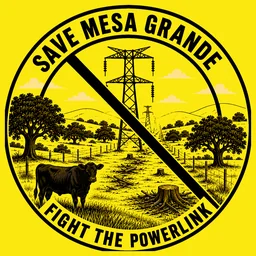
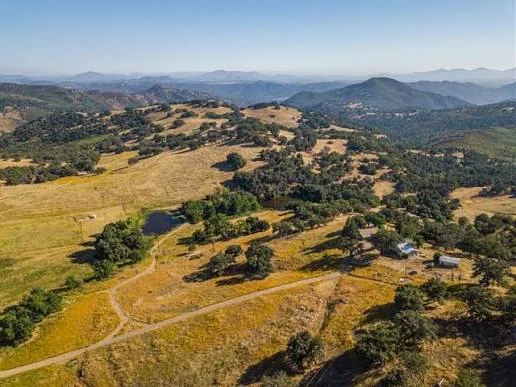
Mesa Grande sits on a high shoulder of the backcountry between Santa Ysabel and Lake Henshaw. It is ranch country and has been for generations: cattle on open grassland, stock ponds, dirt roads between gates, and groves of old oaks standing where they have stood for centuries. There is no town centre and no stoplight. What there is, is room — and a skyline with nothing on it.
A 500 kV transmission line is not a row of wooden poles. It is a procession of steel lattice towers, each as tall as a twenty-storey building, standing in a cleared right-of-way that has to be kept cleared for as long as the line is live. On a landscape like this one there is nowhere for that to hide.
What lives here
The county's Santa Ysabel preserves begin just down the road, and they are a fair guide to what shares this ground. The county describes the largest concentration of Engelmann oaks anywhere in the state there — a tree found almost nowhere outside Southern California. Deer, coyotes, hawks and wild turkeys are an everyday sight; golden eagles, mountain lions and horned lizards are recorded too. The headwaters of both the San Diego River and the San Dieguito River rise in these hills.
A cleared corridor cuts oak woodland into pieces, and it puts tall structures and energised conductors into the airspace that eagles and hawks hunt in.
Fire
This is the part that nobody in Mesa Grande needs explained to them.
At 12:35 on the afternoon of 21 October 2007, in Santa Ana winds, SDG&E power lines started a fire in Witch Creek canyon, near Santa Ysabel. It burned 197,990 acres, destroyed 1,265 homes, killed two people, and reached the suburbs of San Diego. The Mesa Grande reservation was evacuated. State regulators later refused to let SDG&E pass its uninsured costs from the 2007 fires on to ratepayers, finding the utility had not managed its system prudently.
The Powerlink would bring that same company's equipment, at the highest voltage it operates, across grass and oak that cure to tinder every autumn — in a place served by a single winding two-lane road. People up here have watched that smoke column once already. They are being asked to live beside the kind of thing that caused it.
Gem country
Mesa Grande is known far beyond San Diego County for something under the ground. The Himalaya Mine, discovered in 1898, was for much of the twentieth century one of the largest producers of gem tourmaline in North America, and crystals from these hills sit in collections around the world. It is a small, specific piece of California history, and it belongs to this place.
What we are asking for
The same thing as every community in this coalition: stop greenfield expansion for power needs, and focus instead on existing routes, with new technology. Corridors that already exist can carry far more power than they do today, with modern conductors and grid-enhancing technology, without cutting a new one across open country.
Nobody in this coalition is asking for the line to be sent to somebody else's town. The ask is that a new corridor not be cut at all.